The Haven Fire and Poison-Zone Disaster
The TommyknockersThe Haven Fire and Poison-Zone Disaster is the catastrophe that transforms a fire in the woods near Haven into a regional emergency. The flames spread toward Newport, but the more immediate obstacle to rescue is an unexplained toxic zone around the town: people become gravely ill as they approach, vehicles fail, and attempted intervention adds to the death toll. By nightfall, the National Guard has isolated Haven, while reports of lethal air and a vast unidentified craft rising from the smoke carry the event far beyond the town.
Causes and Background
Haven’s emergency follows the town’s transformation into a place cut off from ordinary outside knowledge and movement. Earlier, Roberta “Bobbi” Anderson had argued against reporting the buried craft to the authorities, anticipating that outsiders could take control of the land and spacecraft and impose a cordon around Haven. In the days leading to the disaster, the townspeople’s growing mental connection lets them act as a network, but it does not produce cooperation or shared judgment. During the search for David Brown, the linked residents recognize that he is not simply missing: their collective reach cannot find him because he is “not-there.” Meanwhile, Ruth McCausland, increasingly conscious that the town’s new, apparently effortless knowledge is changing Haven for the worse, refuses to leave and insists that it is still her town. These details make the later perimeter more than a response to flames: Haven has already become a closed and altered community before the outside world moves to close it off in turn.
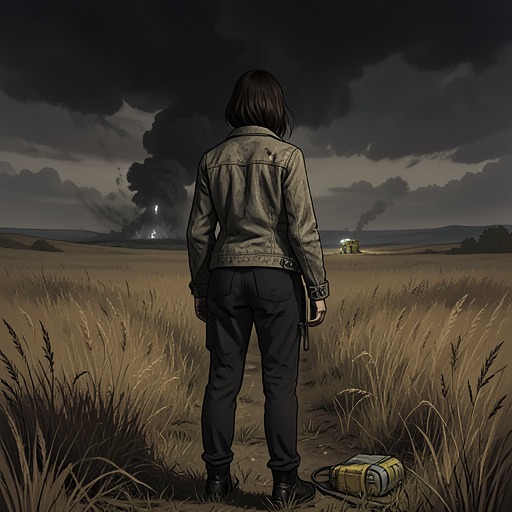
The fire itself is first reported as a forest fire in Big Injun Woods, a name that the account connects with the changed map designation “Burning Woods.” A fire-watch station in China Lakes had logged smoke more than an hour before the report reached Andy Torgeson and Dawson. Ranger Station Three could not determine whether the fire was in Frank Spruce’s east pasture or already a mile inside the woods; with no contact from anyone in Haven, it sent conventional engines, three two-person crews in four-wheel-drive vehicles, and a spotter plane. The distance and uncertainty made the initial response a problem of surveillance and location, but the danger was already spreading beyond what those procedures could safely reach.
The Poison Zone and Failed Response
The Unity fire engines reached the danger first. Three or four miles from Haven’s town line, while the smoke was still at least eight miles away, all seven crew members began to feel ill. Their driver lost consciousness, and the pumper crashed in the woods a mile and a half short of town. Three crew members died in the crash, two more later died from their injuries, and the two survivors made their way out while ill. The responders described the effect as resembling exposure to gas. Their experience established that the emergency was not confined to the burning woods: simply approaching Haven could be fatal.
Other response efforts confirmed that the hazard had no straightforward explanation. No fire unit managed to reach Haven. The units from China and Woolwich came closest, apparently because they were approaching from upwind, with the wind carrying the polluted air away from them. Woolwich’s engines failed completely near the town line. China sent a pumper and a tanker; the pumper stopped working, while the tanker managed to reverse out of the danger area with sick crew members aboard and clinging to it. They suffered severe symptoms, including bleeding, and all had lost teeth. A Newport forest ranger, Henry Amberson, also died. The authorities could report that people became sicker as they drew nearer to Haven and that something was burning, but they could not identify the cause of the poisoning.
The fire’s reach and the poison zone produced overlapping emergencies. The spotter plane crashed, and a bus carrying seventy National Guardsmen from Bangor ran off the road, struck a tree, and exploded after its driver died. None of the Guardsmen survived; the account says that some died in the crash and the others while trying to escape through the contaminated area. The approaching easterly wind made containment still less likely. The fire could not be reached safely, and the changing wind threatened to carry the danger outward rather than hold it near the town.
Fire, Flight, and Containment
As reports accumulated, the smoke drew people toward the area. By seven that evening, hundreds had arrived, including would-be firefighters and onlookers. Many turned back ill, and some died on or beside the roads. When the wind shifted, residents in eastern Newport were also exposed; about a hundred died, many in their homes. The fire, meanwhile, had burned half of Newport before firefighters could properly tackle it, and the fire line had grown to nearly six miles. The disaster thus made distance an unreliable safeguard: the town’s danger crossed its boundary on the wind, while the flames inflicted damage at a scale that overwhelmed local response.
By nightfall, the National Guard had cut Haven off from the outside world. Guardsmen surrounded the town, with those downwind wearing oxygen equipment. The first perimeter was thin, but reinforcements arrived from Limestone, Presque Isle, Brunswick, and Portland; by dawn, a further thousand battle-equipped Guardsmen had been flown in from cities along the Eastern Corridor. This was a response to both the spreading fire and the inability to enter the town safely. In practical terms, the barrier kept people from approaching a lethal zone; it also made Haven a place enclosed by military control.
The scale of the event drew the national security apparatus into the crisis. Between 7 p.m. and 1 a.m., NORAD stood at DEFCON 2, while the President circled the Midwest aboard Looking Glass. The FBI arrived at 6 p.m. and the CIA at 7:15; by 8 p.m., the agencies were disputing jurisdiction. At 9:15, a CIA agent shot an FBI agent in an incident that was hushed up. The narration’s grim comparison is that the Dallas Police had arrived and were already in control of the situation: the official response’s jurisdictional conflict echoes Bobbi’s earlier warning that handing over the spacecraft would not leave her or Haven in charge.
Consequences and Significance
The disaster’s human cost extends beyond those caught in the initial crash or fire. People who came to investigate the smoke encountered the same poisoned air as the responders, and residents outside Haven were exposed when the wind changed. The account distinguishes these deaths by circumstance: some died in their homes, others along roads after attempting to approach or flee. Meanwhile, the fire’s growth from an uncertain report to a six-mile front and the destruction in Newport show how the inability to reach the source compounded the emergency. Neither ordinary firefighting nor the first wave of military intervention could operate normally in the contaminated area.
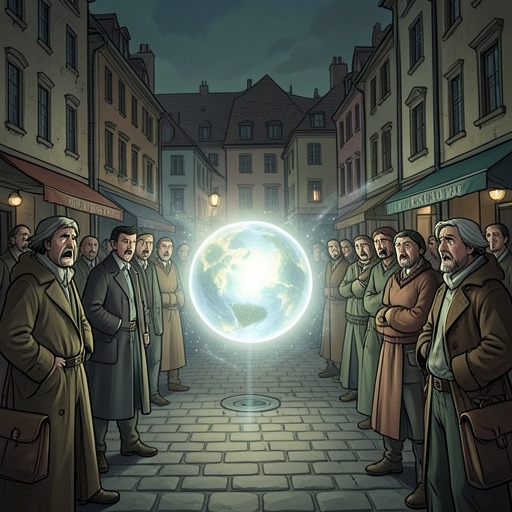
The fire also brings Haven’s previously hidden transformation into public view. Until then, the town had been a quiet place away from Maine’s major tourist routes; now smoke drew crowds, failed engines and casualties generated reports, and a huge unidentified object was seen rising from the smoke in Big Injun Woods. By the time Torgeson and Weems walked out of the polluted zone into Troy, they could provide the first official account of what was happening, but hundreds of unofficial reports about the lethal air and thousands about the UFO had already circulated. The information arrived in fragments, without a reliable explanation, even as the state, military, FBI, and CIA converged on the scene.
The event’s central reversal is that a disaster whose visible sign is fire cannot be addressed as a fire alone. Smoke draws outsiders in, but the air turns approach into danger; military forces arrive to impose a boundary, but that boundary also confirms Haven’s separation from the outside world. The town’s altered collective life, the residents’ inability to retrieve David Brown, and the earlier fear that the government would seize control all meet in a crisis where knowledge and access are divided: the authorities can surround Haven, yet the cause of its lethal zone remains beyond their grasp.